


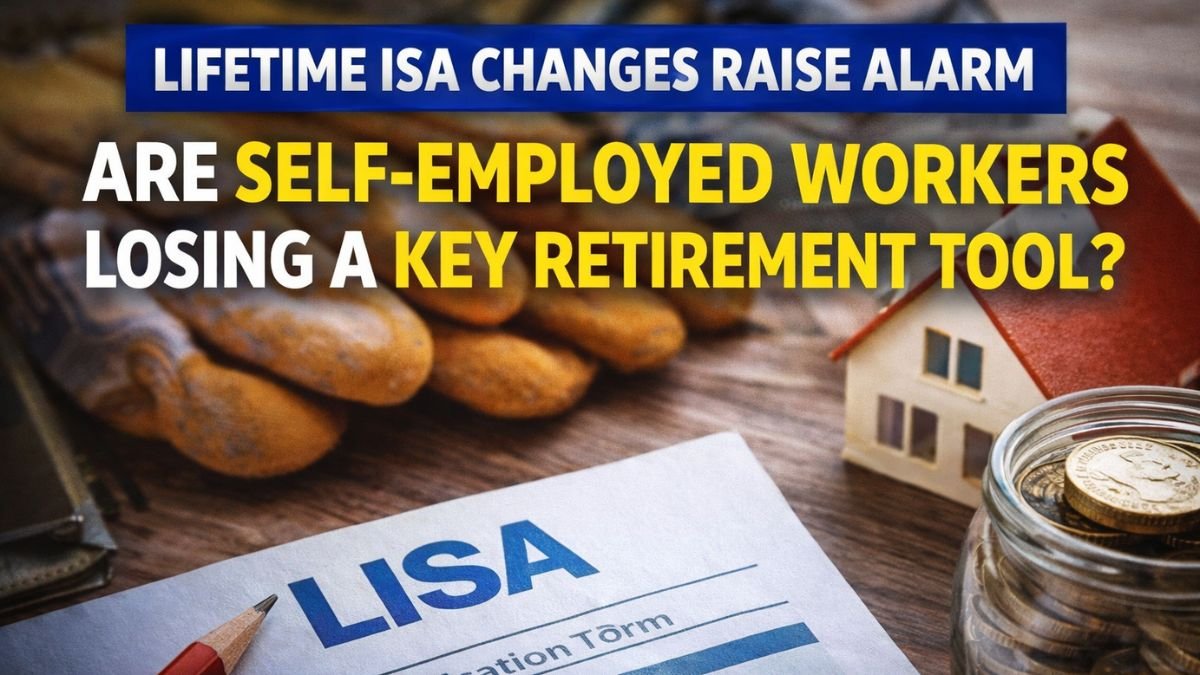
The UK Government’s decision to phase out the Lifetime ISA (LISA) has sparked growing concern, particularly among self-employed workers who rely on it as a flexible retirement savings option.
Announced in the November Budget, the Treasury confirmed plans to replace the current scheme with a new, simplified ISA focused mainly on first-time homebuyers, expected to launch by 2028.
While the move aims to streamline savings products, critics warn it could leave millions without a reliable way to build retirement savings.
What Is Changing with Lifetime ISAs?
The Lifetime ISA, introduced in 2017, allows individuals to save either for their first home or retirement, offering a 25% government bonus on contributions. Over the years, it has gained popularity as a dual-purpose savings tool.
Under the proposed changes:
- The existing LISA scheme will be phased out
- A new ISA product will focus primarily on first-time property buyers
- Retirement savings through LISAs may no longer be supported for new users
Although existing account holders will likely be able to continue contributing, future savers may lose access to this option.
Why This Matters for the Self-Employed
The biggest concern revolves around the UK’s 4.25 million self-employed workers, many of whom do not have access to traditional workplace pension schemes.
Key statistics highlight the issue:
- Only 1 in 5 self-employed individuals contributes to a pension
- Average pension savings for self-employed workers: £26,500
- Average for employed workers: £86,700
Without employer contributions or automatic enrolment, self-employed individuals often rely on alternatives like LISAs to build retirement savings.
The removal of this option could widen the already significant savings gap.
Growing Popularity of Lifetime ISAs
Lifetime ISAs have seen rapid growth in recent years:
- Active accounts increased by 45% in the past two years
- Total accounts reached approximately 964,000
- Around 45% of users primarily use LISAs for retirement savings
This data shows that LISAs are not just a housing tool—they are a critical retirement solution for many.
Expert Concerns About the Policy Shift
Financial experts and industry leaders have voiced strong concerns about the changes.
- AJ Bell warns that focusing only on homebuyers reduces retirement options
- PensionBee highlights that frequent policy changes discourage long-term planning
- Aviva points out that self-employed workers already face higher risks of inadequate retirement savings
These concerns emphasize that removing LISAs could leave many individuals financially vulnerable in later life.
Real-Life Impact on Savers
For many individuals, LISAs have become a cornerstone of retirement planning.
- A London-based IT worker has saved £76,000 since 2017
- A Bristol-based dietician has accumulated £40,000
Both rely on the government bonus as a strong incentive to save and view their LISA as a pension alternative.
Their stories highlight how important this product has become, especially for those without traditional pension support.
What Could Happen Next?
The Pensions Commission is expected to release an interim report soon, which may include proposals to address the retirement savings gap among self-employed workers.
Potential solutions could involve:
- Expanding pension access for self-employed individuals
- Introducing new incentives for long-term savings
- Reforming existing financial products
However, until clear alternatives are introduced, uncertainty remains.
The planned changes to Lifetime ISAs represent a significant shift in the UK’s savings landscape. While simplifying financial products may benefit some, the removal of a flexible retirement savings option could negatively impact millions—particularly the self-employed.
As the gap in retirement savings continues to grow, the need for accessible and reliable financial tools becomes even more critical.
Policymakers will need to ensure that any replacement scheme provides adequate support for long-term financial security.